If you want to understand what’s wrong with youth sport, don’t start with theory.
Start with a minivan at dawn.
A parent is driving two hours to a tournament their kid might not even play in. The kid is half-asleep, clutching a sports drink, already sore. The weekend is gone before it begins. The family budget is quietly bleeding: fees, uniforms, private lessons, hotels, gas, “mandatory” fundraising. Meanwhile, the coach is watching a clipboard like it’s a futures market—who’s in, who’s out, who’s rising, who’s now “behind.”
This is the youth sport world many families now inhabit: a world that looks like opportunity from the outside and feels like a treadmill from the inside.
And the tragedy is that the raw material—kids—still love the core thing. They still love movement. They still love the moment a ball meets an implement and does what they meant it to do. They still love the joy of getting better.
What they don’t love is everything we’ve wrapped around it.
Youth sport is not collapsing because play is unpopular. It’s collapsing because the structure has drifted away from childhood and toward adult incentives: revenue, prestige, scarcity, selection, and status.
Here are the three pressure points that turn the whole system toxic:
1) Scarcity becomes the organizing principle
Traditional sport, especially in school and club systems, is built around limited slots: limited teams, limited facilities, limited coaching time, limited seasons, limited attention. Scarcity forces selection. Selection creates anxiety. Anxiety creates a market. The market creates a system that feeds on its own pressure.
When scarcity dominates, the question stops being “How do we develop kids?” and becomes “Who gets the slots?”
That is not youth development. That is sorting.
2) Cost becomes destiny
Once the pathway to quality reps and quality coaching becomes expensive, talent is no longer discovered; it is purchased. Families who can afford the machine get more chances at progress. Families who can’t are asked to accept that their child is “not that into it” or “not that good.”
But the truth is simpler: reps create skill. Access creates reps. Money buys access.
3) Kids leave
Burnout. Injury. Social pressure. Boredom. Shame. “Not making the team.” “Not getting minutes.” “Not worth the travel.” The numbers don’t matter as much as the pattern: too many kids exit sport early, and when they do, they don’t just lose fitness. They lose one of the best engines of confidence and belonging they’ll ever have.
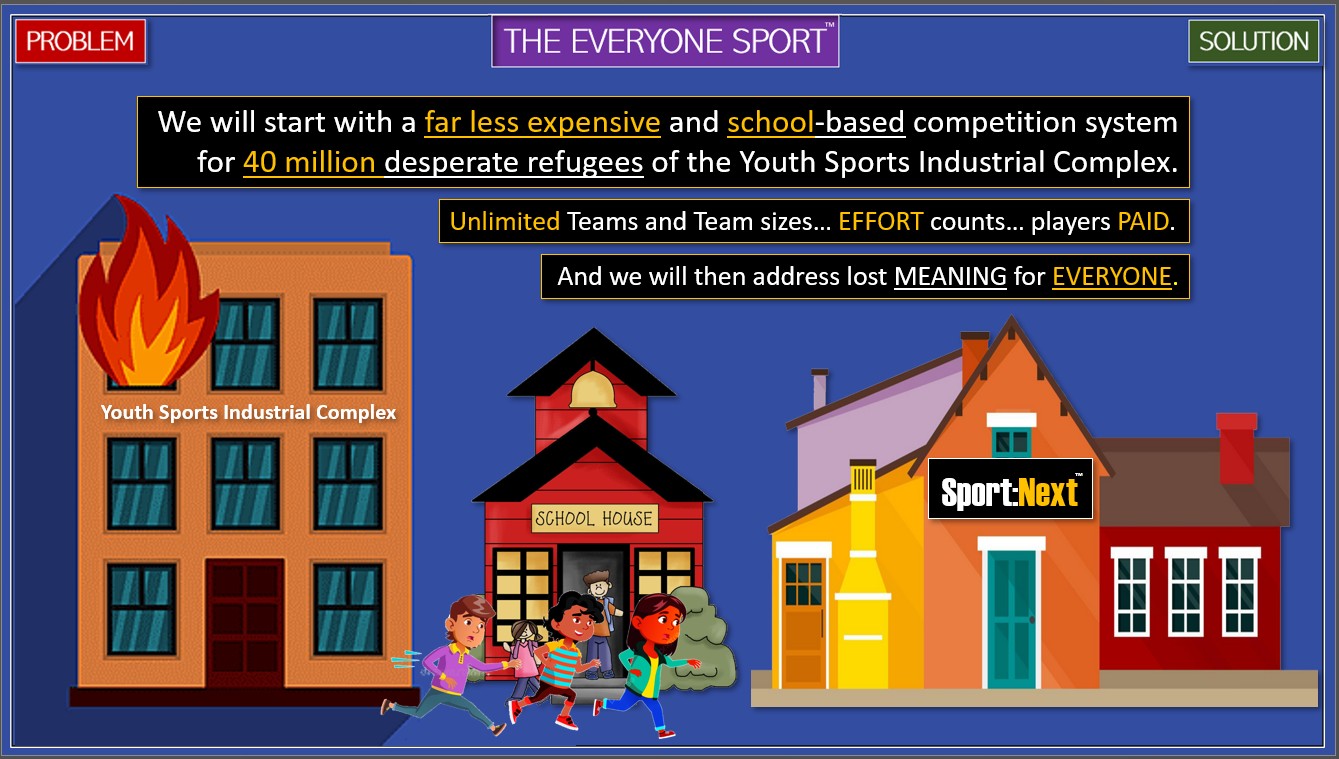
So that’s the Problem in the present tense: youth sport is failing at scale.
Now the Solution must do one thing above all:
It must make practice abundant.
Because practice—reps—attempts—daily engagement—is the missing currency. The kids who get abundant reps improve. The kids who don’t, don’t. And the current system is terrible at distributing reps fairly.
What if it weren’t?
What if the default mode of youth sport were not:
-
“drive to the place”
-
“wait for your turn”
-
“play a little”
-
“go home”
…but instead:
-
“play daily”
-
“get measured”
-
“see progress”
-
“belong to a team”
-
“compete in a season”
-
“improve because the reps are there”
That is what a VR-native sport can do—specifically Racket:Next as the on-ramp for The Everyone Sport (E-ONE).
The key is not “VR.” The key is sport architecture.
A young player clears a small safe space. They put on the headset. And crucially: they pick up the sport’s instrument—the racket. Not a generic controller full of functions. A tool with a single purpose: to be the implement of the sport. That one design decision matters more than most people realize. It tells the body how to move, and it tells the mind what this is:
This is not gaming. This is training.
Heft and windage—just enough physical truth in the hand—turn motion into mechanics, and mechanics into skill. The environment provides clean feedback. The repetition becomes satisfying. Improvement becomes visible, which is the greatest drug in youth sport: not winning, but getting better.
And once you have daily reps, you’ve broken the back of youth sport’s worst scarcity. The kid who can’t afford club travel can still train. The kid who doesn’t make the roster can still improve. The kid who’s shy can still build confidence before stepping into public competition. The kid who loves the game but hates the politics can still play.
So the first win is immediate: youth sport becomes more inclusive, more frequent, less dependent on adult logistics, and less hostage to money.
Now—only now—you earn the right to talk about the second horizon.
Because the same structure that fixes youth sport also prepares society for what comes later.
If artificial general intelligence (AGI) weakens the role of work as the default meaning engine, the world will need scalable structures that turn human effort into identity and belonging. Sport is uniquely suited to do that—because it produces earned reality and shared story without requiring ideological agreement.
But again: the order matters.
You do not pitch the meaning layer first.
You build the youth layer first—because youth sport is where habits form, where culture is seeded, where a generation learns whether sport is “for me” or “for someone else.” Fix that, and you’ve done something valuable even if the AGI future arrives slower than expected.
Then, as the world shifts, the same system can expand naturally:
Youth sport becomes lifelong sport.
Lifelong sport becomes mass participation.
Mass participation becomes a new social layer of meaning.
So the “Problem — Solution” pairing is not abstract, and it is not primarily future-tense.
Problem (Now): youth sport has become scarce, expensive, political, and exclusionary.
Solution (Now): make sport daily, accessible, measurable, and genuinely inclusive—by design.
Transition (Later): the same architecture becomes a meaning structure for a disrupted adulthood.
That is the logic.
Start with kids.
Save sport where it is bleeding now.
And in doing so, quietly build the system the future will need.

